Being a teenage girl isn’t fun. You constantly compare yourself to your friends, to your favourite celebrities, and in the age of social media, you can even compare yourself to strangers on the internet. Often though, what we see on social media is a distorted view of reality – especially when it comes to selfie editing apps.
Back in the days of good old MySpace and Bebo, people wouldn’t really think twice about uploading a slightly unflattering photo if it was of a special occasion, or a hilarious moment. It’s arguable that the social media landscape in the 00’s was much more of a realistic reflection of our actual lives, in comparison to the perfected ‘look how amazing my lunch is’ posts that we share online today. When it comes to selfies, many celebrities have edited their bodies to look thinner, curvier or just that little bit more perfected, but then have been caught out due to weird wonky lines in the background behind them. When editing with apps such as AirBrush or Perfect365, the user has to pinch and swipe in order to get the body shape that they want, and the editing can be made obvious if the app alters the shape of their surroundings too. Which poses the question, why can’t we just be happy with what we’ve got naturally?


What Photoshop is to the magazine industry, these editing apps are to social media. If young people see their favourite celeb looking #flawless on Instagram, they too are going to want to play God with their face by using an app to zap away their spots and under eye circles with just a few taps on a screen. The problem? This warped reality is having a serious affect on the self esteem of teenage girls and boys.
Deanne Jane, the Founder and Principal for the National Centre for Eating Disorders, talked to The Debrief about this matter, claiming: “It’s bad enough that the media Photoshops every image that comes about so that women can look at images of beauty which have nothing to do with reality and start to judge themselves negatively. Now they could start changing their appearance with this do-it-yourself Photoshopping, all that’s going to do is plant in their own brain an image of the perfect self with which they will start to compare their real self.
“We’re now living in a kind of an era where there is just so much available at the touch of a button that will serve to dent body image in young women.”
Here at Canvas we decided to try one of these selfie editing apps out for ourselves. Our Editor, Megan (@meganfife), downloaded the AirBrush app to see what kind of changes she could make to her face.
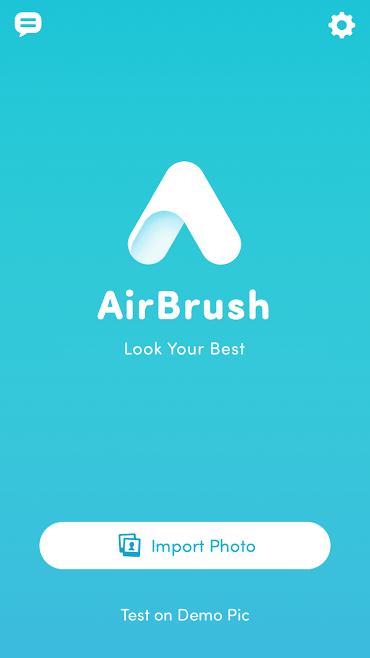
“Okay, let’s try this out. To be honest, I’m already a bit annoyed by the ‘Look Your Best’ slogan on the home screen… who says you can’t look your best without using some dodgy face perfecting app?
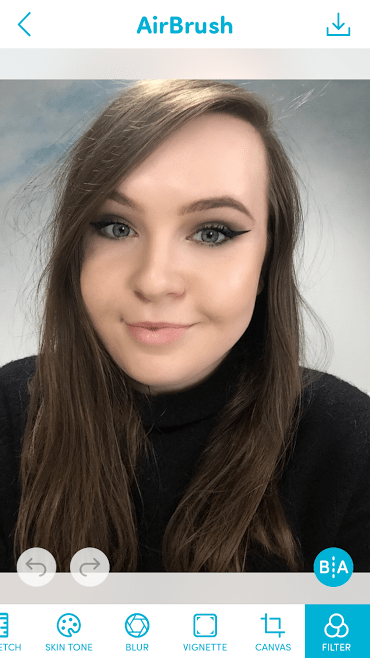
“The image I’ve chosen to ‘AirBrush’ is this one of me looking rather dishevelled and in dire need of a power nap on a Thursday afternoon. Not the worst selfie in the world, but not the kind that would make it to my Instagram feed any time soon.
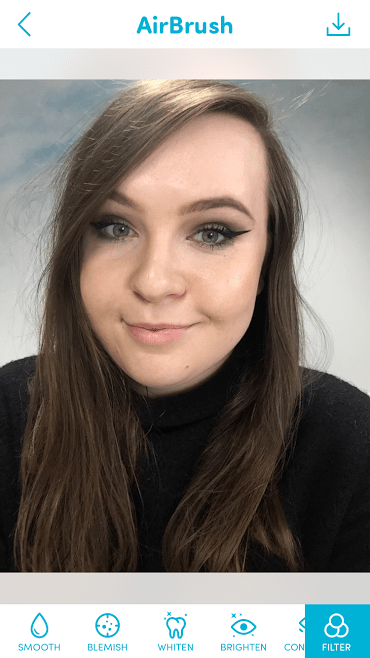
“The app has a user friendly interface, with a variety of editing tools at the bottom. Firstly I decide to ‘smooth’ my face, and I’m immediately taken aback by just how very smooth I appear to be. My skin looks like it has the texture of that red wax used for Babybel packaging.

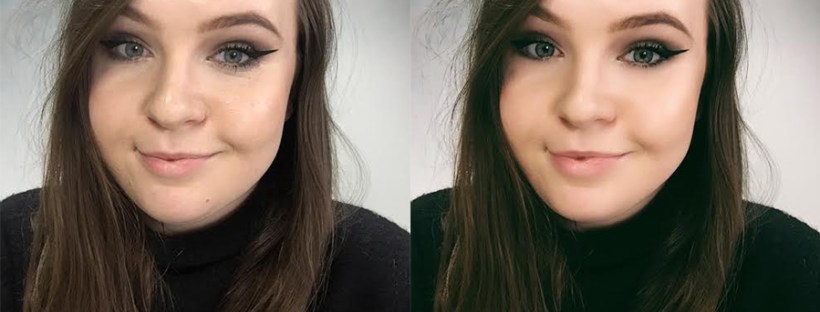
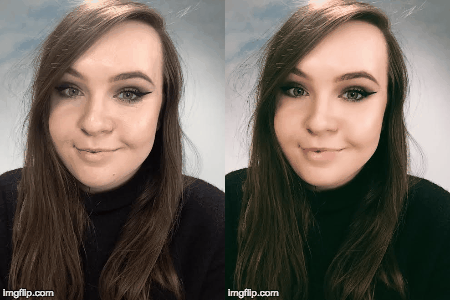
For comparison, the right hand side of my face has been ‘smoothed’ on the above image.
“So now that my skin looks like something from a Madame Tussauds showroom, I decide to resize my eyes, nose and mouth and make my jawline sharper. Just like God moulding people out of Play-Doh. Also, the blemish app is better than any concealer I’ve ever used. My freckles? Gone. Under eye bags? Obliterated. Any blemish on my face has bitten the dust.

“The resize tool makes a circle appear on the screen which you can make bigger or smaller by just dragging your finger. It’s surprisingly (and disturbingly) easy to change your facial features. After making my eyes and lips bigger and forehead and nose smaller, I then used the brightening tool to make my eyes pop a bit.
“When looking at the images side by side, I really hate that I prefer the edited one. Looking at the comparisons makes me hate the original photo – it made me go from ‘probably not the best image’ to ‘oh my god that’s horrible’. After adding a filter, I really don’t think that my face in the altered image is noticeably edited, I just look like a super enhanced version of me. But I still think there’s a problem there. My skin could never be that smooth naturally, and my eyes wouldn’t be that bright even if I doused them with drops on the daily. When young girls (and boys) look at images of people on social media that have been edited in this way, and don’t realise that they have been retouched, it wouldn’t be ridiculous to assume that these artificially enhanced images are damaging to their self esteem. They’re probably sat asking themselves ‘why don’t I look like that?'”

Lauren Bowden, a Psychology graduate from the University of Lancaster, said: “I have a lot of opinions about why these apps that make you ‘flawless’ are wrong. One is that by making you ‘flawless’ you are being constructed into an ideal that is purely made by society and culture. Go to a tribe in Africa where they wear lip disks and I’m sure the image you get of beauty will not be the same. On a psychology basis, considering theories such as faceism which is the idea that our body is a merely tool for sexualisation and beauty, the norms that these apps socialise into us become part of our self-schema and the perfected images that we see negatively impact our self worth.
“Instead of embracing yourself, these apps reinforce the idea that we should be changing ourselves. And for who? Men? The media? Why should we constantly strive for an external ideal that is forced upon us?”
“In my eyes, these apps are just another tool to mould society into something it isn’t, just like the images presented to us in the media that have been edited by Photoshop and other softwares. They reinforce the idea that we should be a western society’s version of ‘beautiful’. In reality, we should embrace our natural form and appreciate that everyone is unique.”
However, Charlotte Matlock, an 18-year-old Sixth Form student, thinks that these apps are pretty harmless: “I’ve used Perfect365) on one or two selfies before on days where I’ve felt really nice and the selfies don’t show it, but I still want to post a picture. I don’t mind using them as long as you look natural on the photo. I usually use most features but made sure the impact of them was only half, so I don’t fully airbrush my skin or lighten my eyes. I don’t mind them if they’re used in moderation. I think it would be silly if people always used them, it’s just not realistic”.
At the end of the day, not only is social media about sharing your life with your friends, family and strangers on the internet, it’s about self expression. Which means that really, anyone can post whatever the hell they want. It’s important to remember though, that social media is a bit like looking through someone else’s life through rose tinted glasses. What you’re seeing isn’t always reality, and images can be orchestrated or edited in a certain way to look a specific style. “Don’t believe everything you read” has been said for years, but in this day and age “don’t believe everything that you see” is also some pretty damn good advice too.
 Megan Fife
Gorgeous and really enjoyed reading this post! I also do post on Beauty! You should check out my blog! 💋
https://valsvougexo.wordpress.com/
Totally agree with this post! It’s great that so many people are trying to go against this trend and post real photos with no makeup in yoga pants. We love editing apps as well but if you overdo it you just end up hating your original form!
XX, Britta & Carli from http://twinspiration.co/